Chapter 4 - Personal Computers and Cassette Tapes
When computers were introduced to office settings, we had to use these "thin client" computer terminals because it was literally not physically possible to put a computer at every desk. Or any desk really, given how massive they were. But as computers became smaller, lighter, and less expensive to the point they could fit near a desk, we had the personal computing revolution.
The earliest personal computers had no networking of any kind really. The only input and output devices were the keyboard and the display. Better personal computers supported a serial interface to talk with casette tape drives.
Casette tapes, as well as all the magnetic tapes used before in more industrial settings, can encode electrical signals as the orientation of magnetic particles on the surface of a plastic tape. Outside of computers, they were used with a microphone and speaker to encode analog audio data, but computers can deposit digital electrical data directly with no audio step in the middle. Like in the UART example, the "high" spots could be put onto the tape by strongly magnetizing the particles, and the "low" spots could be put on the tape by demagnetizing the particles or negatively magnetizing the particles.
After the electrical signal has been put onto the tape as magnetic fields, that very tape can be physically moved past a coil of wire to generate a current in that wire and reproduce the original signal. This process of encoding and later decoding the magnetic fields does result in a much lower output voltage, so an amplifier is generally used to bring the signal back up to the original voltage level so that (for casette audio anyway) it will be audible over a speaker set.
A 1980s casette deck is, in principle, a device that records electrical signals (e.g. from a microphone) and then reproduces those electrical signals (e.g. into a speaker set). While the original telephones wired microphones directly to speakers, the invention of tape recording and its predecessors like wire recording (same idea, but used thin wire instead of the iron-on-plastic-tape that casettes are known for) allowed the microphone signal to be captured and used again later. But the technology does not have to record audio sources, it can record basically any changing electrical field and store it long-term as a magnetic field.
The 1983 movie WarGames is a classic film that contextualizes many early personal computing concepts. In the film, high schooler David Lightman finds himself having accidentally hacked a United States nuclear warhead control facility after connecting to it under the false belief that the system belonged to a computer games company. He was trying to get early access to some unreleased video games, but instead tapped into the supercomputer AI that controls the launch of ICBMs. At one point in the film, David gets locked into a secure room at the facility which has an electronic door access system. Using his pocket-sized portable casette deck, he taps into the wiring of the electronic access system and uses the casette to record the electrical signal that his captors send to unlock the doors. Later, he reverses the wires so that instead of recording, the cassette deck allows him to play back the recording, and the door pops open.
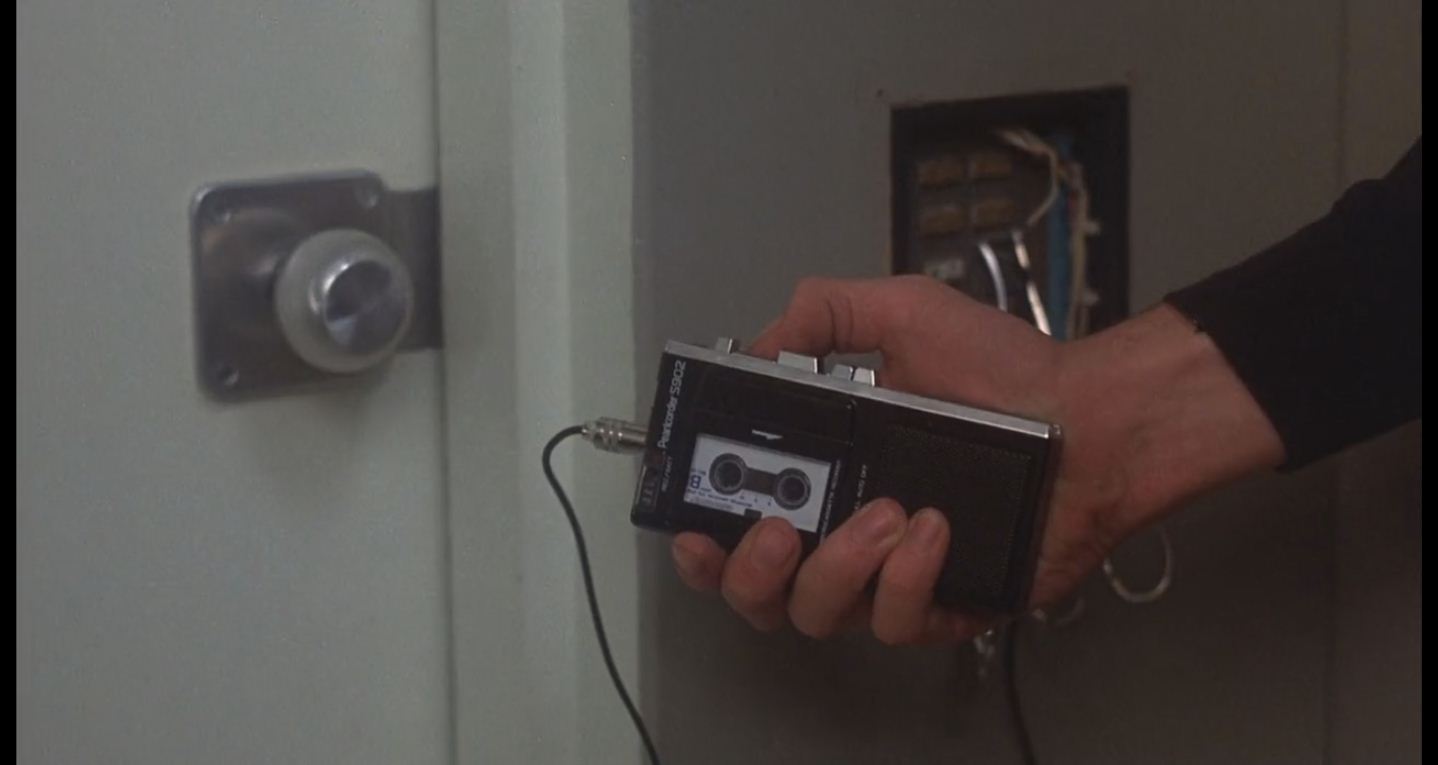
Frame from the 1983 film WarGames depicting teenager David Lightman executing a replay attack on a door access control system.
There is some controversy over whether this would work in practice, but the idea is that because these systems were (and many systems actually still are) rather primitive, simply re-playing the same electrical signaling commands to the door system made it open right up. This kind of thing, called a "replay attack" allowed him to escape. These days, replay attacks are still used to do things like break into (30+ years old old, insecure) cars by replaying the radio signals sent by car key fobs.
Anyways, the point I'm trying to illustrate is that electrical signaling and audio systems are fundamentally compatible. By the time that personal computing was widely available, we already had tons of ways to distribute sound. Television, radio, telephone, cassette tape, vinyl. All of these have been used to store and transmit computer data (even vinyl records).
There used to be a promotion where you could get free software for your personal computer through what was essentially a radio advertisement that ended with the sounds needed to reproduce the programming once it had been recorded to a casette and then played back. Real nerdy stuff.