Chapter 13 - Firewalls
This is great but it's a little too great. Because I can print to your printer when you want, but I can also print to your printer when you don't want. And anyone who has your IP address can print to your printer when you don't want. Printer ink and toner are expensive, paper is expensive.
With Fax machines there was some idea of a black fax attack where a malicious person could take a fax machine with a continous document feeder, tape a couple of all-black pages end to end, and then run these pages in an endless loop through the fax so that the victim fax machine wastes all its paper and ink.
With this new internet printer, an attacker doesn't even need a continuous document feeder. They can just use a computer program that sends a new print job every couple seconds.
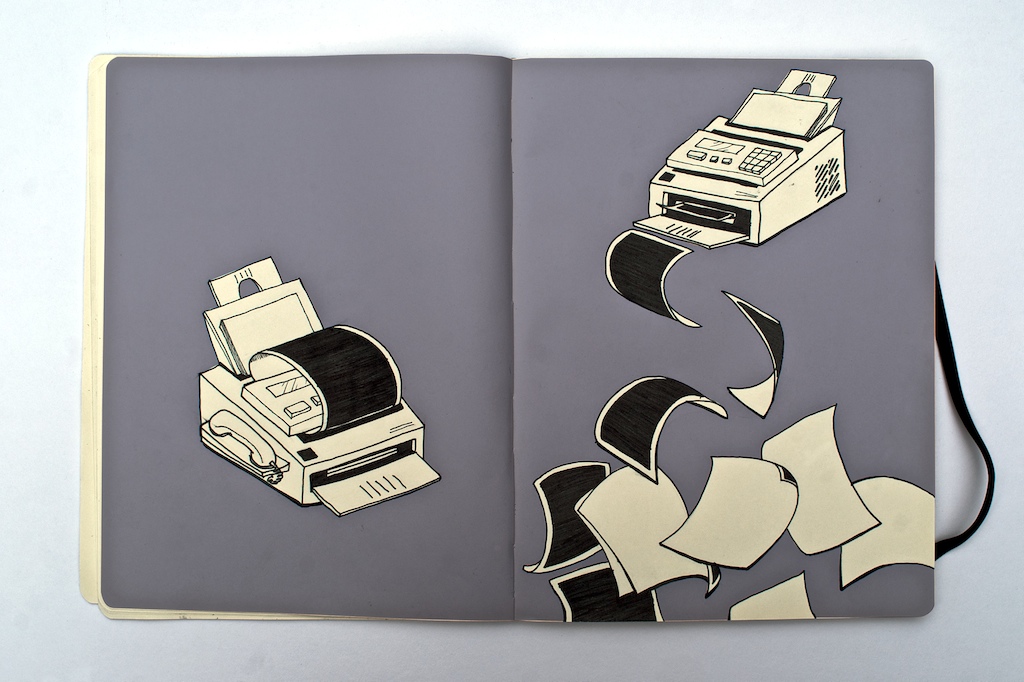
An illustration of the Black Fax Attack by artist Ricky Trickartt (via flickr).
On a telephone, there's usually a feature somewhere to make the phone automatically reject calls coming in from unknown phone numbers. This allows people to avoid annoyance from spam calls, and fax machines to avoid malicious faxes coming in from bad actors.
On the Internet, a very similar effect is achieved using a device called a firewall.
The original firewalls were physical boxes that did just firewall work. These days, firewalls are mostly just programs that run on basically everything that has a network interface. You can still buy physical firewall boxes, but they're usually only seen in companies big enough to have dedicated network engineer staff.
A Firewall's job is pretty simple. It acts a lot like a bridge, where it takes messages that come in on one side, and just repeats them onto the other side. But instead of blindly repeating all messages, it has a list of rules. In this scenario, the rule list would look something like this:
- Allow traffic from the internet side that's coming from 18.43.64.1 (g's PC) and going to 15.23.44.2 (Alisa's printer)
- Allow traffic from Alisa's side that is coming from or going to anywhere
- Do not allow any other traffic
With these rules in place, my print jobs can pass through the firewall but everyone else's get rejected. Your print jobs can make it to the printer perfectly fine because they don't have to go across the firewall; you're inside the network that the firewall protects.
Tangentially, even today not everyone puts a firewall between their printer and the Internet. See here: https://cybernews.com/security/we-hacked-28000-unsecured-printers-to-raise-awareness-of-printer-security-issues/ an estimated 500,000 printers are just out there, happy to print anything anybody sends from anywhere.
The Internet, broadly, worked this way for years. However, things got shook up quite a bit with the introduction of Wi-Fi